Summer Office Hours: Tuesday – Thursdays 10:00 AM – 4:00 PM (Appointments by Request)
Office hours: Mon-Thu 7:45 AM-4:00 PM | Fri 7:45 AM-2:00 PM
(916) 481-2300
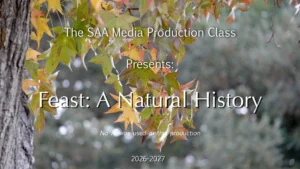
This year, Mr. Janke and his high school Media Production class made a Thanksgiving video together. Some students stepped in front of the camera to narrate. Others worked behind it, filming the shots. And together they turned it into something none of us saw coming: a documentary in which every narrator sounds like an old British man.
At SAA, a Pre-K-12 Christian school in Carmichael, California, our Media Production class is part of the applied arts elective program, and its goal is simple: to help students find new ways to use the creative gift God gave them. This Thanksgiving, they made something we’re proud of. And here’s the detail that matters most: the video used no AI. Not a single voice, not a single note. It’s a real example of what a strong academic program provides: quality expertise, real skills, and students doing professional-grade work with their own hands.
Key Takeaways
The class set out to celebrate Thanksgiving (the food, the traditions, the gratitude) with one creative constraint that changed everything. Some students narrated, and their voices would be transformed to sound like an old British man narrating a documentary. Others worked the camera, filming the shots that made up the final product. Mr. Janke worked alongside them the whole way. Everyone had a hand in it.
The result is equal parts hilarious, impressive, and quietly profound. You can watch the full Thanksgiving Day video right on our website.
Here’s the part that surprises people: the voices were never replaced. Think of it like a guitar pedal. When a guitarist steps on a pedal, it doesn’t play the guitar for them. It takes the notes they’re actually playing and reshapes the sound, the tone, the texture, the character. The performance is still theirs, still driving every note.
The class did the same thing with voices. Each narrator’s real performance, with all its timing and personality, is still there doing the work. Then a chain of audio processes in DaVinci Resolve changes the tonal quality, the pitch, and the texture of everyone’s voice, so it comes out sounding similar to one old British man. In music terms, the original voice is the trigger, like a MIDI note, and the effect is the instrument that gives that trigger its new sound.
That’s what sets this apart from AI voice generation. AI would build a voice from scratch, or clone someone else’s. Our approach keeps the human performance as the source. The student narrator is the guitarist. The effect is just the pedal.
The score was composed by Mr. Janke using MIDI plugins and samples. Every note was placed by hand, timed to the edit, and mixed to match the documentary tone.
It’s also a preview of what we plan to come to our high school and middle school curriculum. The school was recently gifted Ableton (by Ableton), one of the most widely used professional music software programs in the world. Producers and composers rely on it every day. That valuable gift means students in middle school and high school will learn to write and record their own music, in Media Production and other classes, later in the year. The score you hear in this video is a first taste of what they’ll be creating themselves.
Let’s start with the obvious: no AI was used anywhere in this film. Not for a voice, not for a note. AI tools are impressive, and they’re everywhere now, but this video isn’t a story about humans keeping up with machines. It’s the other way around.
AI can generate a voice. It can’t generate a performance. The timing, the delivery, the personality, the small imperfections that make the whole thing funny and warm and real, those came from actual students and staff, in front of the microphone and behind it. They needed each other and a good process.
Feed the same idea to a machine and you’d get something technically ok and completely forgettable. This video is memorable precisely because it’s human. The human performance, the human touch, is the far superior product.
And underneath all of it is the reason this class matters to us in the first place. As Mr. Janke puts it, “We believe creation is one of the most wonderful gifts God gave us. AI wasn’t given a gift in the book of Genesis. We were and this is an opportunity for our students to use that.” The goal of this class is to help students find new ways to use the creativity God gave them, and this video is what happens when they do.
That matters far beyond one video. Employers consistently rank creative thinking among the most important skills for the future workforce, and the World Economic Forum’s Future of Jobs Report places it near the top of the list. A class that asks students to imagine, perform, and refine isn’t an extra; it’s preparation.
The Media Production class is one of SAA’s applied arts electives, and this project shows exactly what the program is built to do. Our students don’t just learn software; they complete real, publishable projects that build the skills colleges and employers actually look for. Learn more about our Student Life and High School programs.
For families considering SAA, this video is a reminder of what’s possible when students are given real tools and real freedom to create. If you’d like to see more, schedule a visit and watch what our students are building.
This one film is a living example of our Schoolwide Learner Outcomes, not a checklist of them:
Underneath all four is our first Schoolwide Learner Outcome: to know and follow Jesus. Using the creative gift God gave us is one of the ways our students do exactly that.
You can read more about all seven outcomes on our Mission and SLOs page.
The class also produced a behind-the-scenes “how it’s made” video documenting the entire process: the raw footage, the voice work in DaVinci Resolve, and the music composition. Watch the how-it’s-made video (Above) to see how a group of high school students turned an idea into a finished film. You can also browse more student work on the SAA media site at media.sacaa.org.
What do parents often ask about the Media Production class?
No, and that’s the whole point. The class didn’t generate or clone any voices. Each narrator’s real performance is preserved, and the effect only changes the tonal quality, pitch, and texture, the way a guitar pedal reshapes the sound of a guitar. The human performance is what makes the video good, and it’s something AI can’t reproduce.
Students work in DaVinci Resolve for editing, color, and audio. They’ll also learn to compose music using Ableton, the professional music software recently gifted to the school, along with MIDI plugins and samples. These are the same tools professional creators use.
Yes. Media Production is part of SAA’s applied arts elective program for high school students. Schedule a campus tour or contact our registrar to learn more.
Both are available right on our website. You can watch the Thanksgiving Day video and the how-it’s-made video, and browse more student media at media.sacaa.org.
The best way to understand what students create at SAA is to see it for yourself. Schedule a campus tour to visit the classroom, meet the teacher, and watch the videos on the big screen. We’d love to show you what your student could build here.